Monday, November 2, 2015

The Serene Sago Palm


This is an outstanding specimen of a Sago Palm, sitting regally, at Flowers and Plants Etc. Sago palms certainly deserve a lot of respect as plant elders. It is said that they have lived on earth since dinosaur times. Although not a true palm, they do have fronds that unfold and appear palm-like. Their fronds are a quite stiff and a deeply peaceful green.

Sago palms grow slowly, forming a trunk that could eventually reach 10 ft. or 3m high. that would take many years indoors. It will produce a few new fronds, all at one time, every year or so.
 
The Sago palm is a member of the Cycad family. The cycads are more closely related to conifers and like them, produce cones rather than flowers to propagate their species. The species shown here is Cycas revoluta and is native to So. Japan and Java.  

These are quite hardy houseplants and can also be used well as a patio plant or for a winter garden. They can survive temperatures as low as 15°F or -10C. Just don't forget to check and see if they need watering during the winter.
 Care Instructions---
  • Bright indirect light or direct morning sun is best.
  • Water when dry about 1" (about 2-3 cm) below the soil surface for plants in a 6" (15 cm) diameter pot  and 2" below the soil surface (5 cm) in an  8" (20 cm) diameter pot. 
  • A moisture meter for indoor plants is a great way to monitor the moisture level of your plants. Soil moisture meters for houseplants are available at garden centers and online.
  • They are tolerant of drying out more if you should forget.
  • Fertilize occasionally.
~~~~

**To see other plants on this blog click here:   The Indoor Garden blog
***For a variety of  video clips on houseplant care from my 90's TV series, click below:
The Indoor Garden TV show

©2015


Tuesday, September 29, 2015

Getting Ready to Bring Houseplants Indoors for Wintertime


It's the time of year for your houseplants, when they should be coming in from the outdoors and returned to the house. Almost all houseplants can withstand temperatures down to about 45°F (7°C), so keep an ear out for night time temperature predictions below 50° F (10°C). Then bring them indoors.

The week or so before bringing your indoor plants inside is a great time to get them in good shape for the winter. Repot any plants that have outgrown their pots over the summer, add potting soil to any plants that need it and clip off dead leaves. 

While they are outdoors, give them a thorough soil soak, by using about three times as much as water as usual, and then let them drain. This process is known as leeching. Not only will that help the roots but can also help flush away any insects in the soil. Leeching helps flush out any salt buildups that that can build up over time from water deposits and fertilizer. This is a good practice to do anyway, every year or so, for all your plants.  

When returning them to the indoors, be sure to place your plants in the best light that you can provide for your specific plant. That will help guarantee the best results over the winter.

Thursday, August 13, 2015

A Fern and Moss Garden


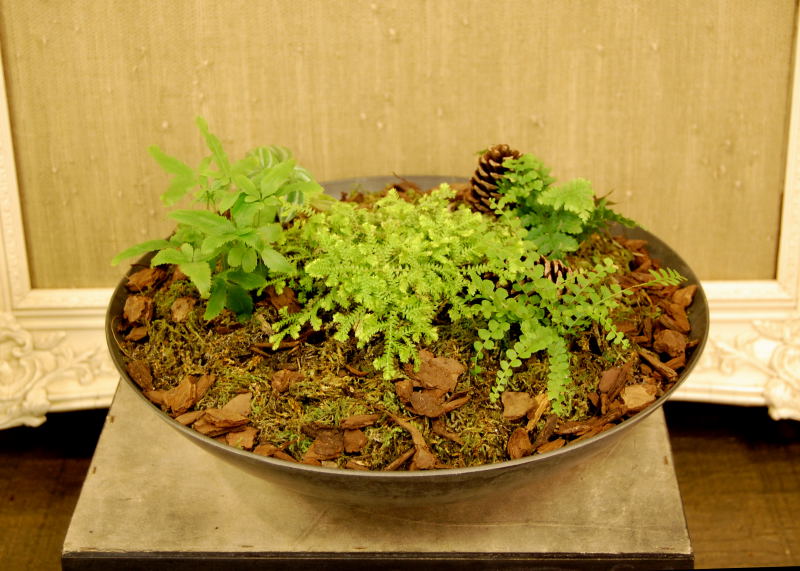
I saw this lovely custom made dish garden at one of my favorite florists. This one, which is made of ferns and moss, is an especially lovely reminder of the quiet of the forest.  

Ferns and mosses are among the plants that have lived on the earth for the longest time. As soft and vulnerable in appearance as they may seem, they do grow quite easily, recover well from setbacks, and propagate in nature, with ease.  

A display like this can last for several months or so but should eventually grow to the point where it will have to be taken apart. Some of the plants could be put into pots or maybe one of the ferns and the moss will still fit together into the dish garden.

It can be an enjoyable craft to put a dish garden together. The secret to success with that is making sure the plants have the same light and watering requirements. Ferns and moss do, so this one should work out well. 

You can send flowers or plants almost anywhere in the world from this florist:

Care Instructions:
  • Bright indirect light or some morning sun is best. Direct afternoon sun will be too strong.
  • A dish garden needs to be carefully and evenly watered. Ferns and moss like to stay on the moist side so water when the top of the soil is dry.  
  • Make sure the dish garden is not "swimming" in water but that is watered enough to soak all the way to the bottom of the container.  
  • It may take a little experimentation in how much water to use but the plants will let you know if you are on the right track.
  • These plants appreciate humidity and a daily mist of water should help.
  • Fertilize occasionally  

~~~~~

**To see other plants on this blog click here:   The Indoor Garden blog
***For a variety of  video clips on houseplant care from my 90's TV series, click below:
The Indoor Garden TV show

©2015


Monday, July 13, 2015

About the Fiddle Leaf Fig


The Fiddle Leaf fig can become a large and peaceful living presence in your home or office. It has wonderful large and shiny fiddle-shaped leaves that are quite sturdy and rigid. They seem to emanate a sense of safety. This is a relative of the old-time favorite, the Rubber Tree and another popular houseplant, the Ficus benjamina. It's a ficus, too, and its botanical name is Ficus lyrata or Ficus pandurata. 

I saw this on a visit to a beautiful florist and just had to snap a picture of this handsome and robust specimen. They are fairly easy to keep but will take awhile to look great again, if they are neglected and start losing leaves. 

Many of the Fiddle Leaf figs you'll find for sale, are in large pots and so will not require water too often. I've found some of my largest plants only need a monthly watering!

These magnificent trees are natives of the tropics of western Africa and may eventually grow as tall as your ceiling. Fortunately, they grow slowly and can be pruned.  


*You can send floral arrangements and houseplants almost anywhere in the world from this florist:   
 
   Flowers and Plants Etc
 
Care Instructions-- 
  • Prefers some direct sun but tolerates bright indirect light. Full afternoon sun may be too strong..
  • Let the top of the soil dry very well or up to a couple of inches below the soil line, then water thoroughly. A plant in a 6" (15cm) diameter pot should use about a pint (almost 1/2 liter) of water. 
  • A plant in a 10" (25 cm) diameter pot should be watered with about 2 quarts (1-2 liters) of water when the soil surface is very dry.
  • A plant in a 14" (35 cm) diameter pot will use about 1 gal (about4 liters) of water when the soil surface is very dry.
  • Fertilize regularly for best growth. 
  • The leaves will need dusting occasionally. A good showering once or twice a year will help keep the leaves shiny and breathing freely. 
  • Summertime is great for cleaning up all your houseplants outdoors. If you place outdoors for the summer, avoid much direct sun; they aren't used to the intensity of the light.
~~~~~

***For a variety of  video clips on houseplant care from my 90's TV series, click below:


Thursday, June 18, 2015

The Hibiscus: A Touch of the Tropics indoors


It feels like the tropics today in the Washington, DC area, which is not particularly unusual for summer. The weather reminded me of the big and bright-blossomed Hibiscus plant, maybe the houseplant that is most reminiscent of the Tropics. These tropical bushes are fairly easy to keep indoors for many years, if you have a sunny area in your home.

Of all the blooming plants that can be grown indoors, these magnificent shrubs probably have the largest and showiest blooms. The hibiscus is native to China, Japan, India and the East Indies and you should find them readily available for sale in an array of bright colors.

If you live in an area with a warm summer, a Hibiscus would benefit greatly from being put outdoors after the temperatures reach about 70°F (or 21°C) during the day. They should be put in a semi-shady outdoors or may have difficulty adapting indoors later. The light outdoors is much brighter than indoors and the sunniest of windows is less than full sun outside. Plants usually do not like to be put in less light than what they've been accustomed to receiving.

They are easy to prune to shape and you may need to, from time to time, as they can eventually grow as tall as your ceiling. With the right care, they can live with you for years! 

Care Instructions--
  • At least 4 hours of direct sun daily is best. Full afternoon sun suits them well.
  • Water a Hibiscus thoroughly, when the soil surface is dry.  
  • Plants in a 6" (15cm) diameter pot need about a pint (almost 1/2 liter) of water
  • In an 8" (20cm) diameter pot use about a quart (1 liter) of water
  • In a 10" (25cm) diameter pot, use about 2 quarts (2 liters) of water
  • In a 14" (35cm)  diameter pot, use about 1 gallon (4 liters) of water
  • Humidity can be provided by daily misting.
  • Fertilize regularly for best growth and most blooms.
  • A Hibiscus should be kept cleaned up, removing any yellowing or dead leaves as soon as possible. Occasional dusting and a gentle showering from time to time is very helpful.
  • If possible, setting them outdoors in a semi-shady spot for the summer will give them a good boost.
  • They can be pruned to shape
~~~~~   
To see a short video clip on the Hibiscus from "The Indoor Garden TV", a 90's TV show, click here: The Indoor Garden TV

For more short videos on a variety of plants, Check out The Indoor Garden TV channel:

©2015

Wednesday, June 17, 2015

Keeping a Pteris Fern


A Pteris fern just naturally grows with a graceful bent to its fronds. They really do look so relaxed. As they mature, their fronds can grow as long as 1-1 1/2 ft. ( 30-40 cm). I recently saw this one, the Pteris cretica, at a great florist in McLean, VA.   

There are several species of Pteris fern, also known as 'table ferns' available on the market today. They've been used as a houseplant and occasionally hybridized since the early 1900's. They are one of the most tolerant ferns to keep indoors and recover well from some neglect. A Pteris fern would be a very good choice for someone who is interested in ferns but doesn't have much experience with them.
 
Pteris ferns can naturally be found in many areas of the subtropical parts of the Eastern hemisphere including Africa, India, Japan, China and New Zealand.
 

~~You can send plants as a gift, or floral arrangements almost anywhere in the world from this florist: 


Care Instructions--
  • Bright indirect light or some morning sun is perfect. Sitting in a north-facing window is ideal. 
  • Ferns must stay on the moist side so give them some water as soon as the top is dry.
  • A plant in a 4" (10cm) diameter pot should require about 1/2-3/4 cup of water. Test to see how much your's needs by observing how much water comes out of the bottom of the pot. A little bit should, to show that it was thoroughly soaked. 
  •  A plant in a 6" (15cm) diameter pot should take about 1 pint (almost 1/2 liter) of water when necessary. 
  • Provide humidity for them. A daily misting is recommended.
  •  You can also put pebbles in their saucer and keep water in the saucer so that the bottom of the pot sits just above water, not in it. The evaporating water does provide some humidity. The Pteris ferns are tolerant of less humidity than some other ferns.
  • Normal indoor temperatures should suit them just fine.
  • Fertilize regularly for best growth
~~~~~

  ***For a variety of  video clips on houseplant care from my 90's TV series, click below:


Thursday, June 4, 2015

Growing the Gorgeously Fragrant Gardenia Indoors


While shopping at my local Garden Center today, I saw that there are now new hybrids of the gardenia that may live through a Washington, DC winter. Good news for backyard gardeners! You do have to live in area with mild winters to keep these glorious beauties as part of your outdoor garden.  You can keep one indoors as a houseplant almost anywhere in the world, if you are able to meet the requirements for its care.

They aren't the easiest of houseplants to keep but it can be done if you are willing to devote yourself to their regular upkeep. If you have a sunny location, can provide some humidity and keep them watered as they like, that will put you in a position to be quite successful with them. Without the specific care required, they tend to be susceptible to insects and disease. 

With their calming deep green glossy foliage, and out-of-this-world fragrance emanating from soft-white flowers, a Gardenia can be a wondrous addition to the ambiance of a home.

These evergreen shrubs are native to Asia and Africa in areas with mild winters. They've been popular as a houseplant for a long time and the newer hybrids tend to be hardier indoors. 

Care Instructions--
  • At least 4 hours of direct sun daily. Full afternoon sun suits them well.
  • Water a gardenia thoroughly when the soil surface is dry.  
  • Plants in a 6" (15 cm) diameter pot need about a pint (almost 1/2 liter) of water
  • In an 8" (20 cm) diameter pot use about a quart (1 liter) of water
  • In a 10" (25 cm) diameter pot, use about 2 quarts (2 liters) of water
  • Humidity can be provided by daily misting. 
  • Or add humidity by setting the plant on a deep-dish saucer filled with pebbles and keeping water in the saucer up to the pebble line so as the water evaporates, it will provide some humidity to the plant.
  • Fertilize regularly. They prefer a more acidic fertilizer such as Miracid by Miracle Gro.
  • Gardenias should be kept cleaned up, removing any yellowing or dead leaves as soon as possible. Occasional dusting and a gentle showering from time to time is very helpful.
  • If possible, setting them outdoors in a semi-shady spot for the summer will give them a good boost.
  • They can be pruned to shape

~~~~~

***To watch short video clips on plant care from my 90's TV series, click below:

  The Indoor Garden TV

©2015

Monday, May 4, 2015

The Gift of An Azalea


As the azaleas begin to bloom in my yard, I'm remembering from the days of working at a florist, how popular a beautiful potted Azalea was to give as a gift in the springtime. With Mother's Day coming up soon, there are bound to many of these prolifically blooming gems sold.  

Azaleas have been grown for commercial floral sales for about 100 years and have graced many homes with their lovely flower masses, for a few weeks indoors. After blooming, depending on where you live, they can become an addition to your garden, if you have a semi-shady spot for one.

It is possible to keep an Azalea as a houseplant but it requires almost the same conditions as a greenhouse would provide. It likes full sun, some humidity and air circulation. It can also be used as a bonsai and if you want to attempt that, I'd recommend a class in this specialized art and science, out of respect for these living things.  

Care Instructions:
  • Direct sun is best; it must have full sun after blooming, if you want to keep it growing. It does tolerate lower light for a little while, if you want to display it in less light for the holidays.
  • Water thoroughly when the top of the soil is dry..
  • Plants in a 6" (15cm) pot should take about 1 pint (almost 1/2 liter) of water. Plants in an 8"  (20cm) diameter pot should take about 1 quart or almost a liter of water, when necessary. 
  • If they wilt, they can be revived. It is probably best to put your plant in the sink or bathtub and really soak it,  then let the water drain out for a few minutes before returning it to its place.
  • A daily mist of water would be helpful. 
~~~~~

***To watch short video clips from my 90's TV series, click below:

©2015

Friday, April 24, 2015

The Very Maternal, 'Mother of Thousands' Kalanchoe


My cousin, Pat, sent me these pictures today so that I could identify her plant. I have seen similar kalanchoes named 'Mother of Thousands', which is a name that suits these plants well!

I believe this one is a hybrid of the Kalanchoe daigremonitiana, which has the same phenomenal way of reproducing. What will those botanists hybridize next? This fascinating kalanchoe will develop masses of baby plants all along the edges of its leaves!

Kalanchoes are easy-to-grow succulents and all produce flowers, some more showy than others. These handsome and robust natives of Tropical Africa and Madagascar are great for beginners to world of houseplant care.

When repotting, if you add just enough sand, to regular potting soil, so that sand is about 10% of the mixture, that would suit them well.Special soil mixes for cacti and succulents should work well also.

Thanks, Pat!


Care Instructions--
  • Requires direct sun for the strongest growth.
  • Water when the top of the soil is quite dry. 
  • Water thoroughly.Fertilize regularly.
 ~~~~~
 
View some video clips on houseplant care from my 90's TV series on YouTube, click below:


©2015

Thursday, April 23, 2015

Elegance Plus: The Kentia Palm


Someone asked me today how to take care of a Kentia palm. I thought that I didn't have a picture of one to use in writing about it, then I remembered that I do have a snapshot of one from "The Indoor Garden", the TV series I made in the 1990's. These very elegant palms need a lot of space but are bound to be a strong, calming presence wherever they are placed. Their graceful fronds are lovely shade of deep olive green.

They are easy to keep but need a devoted owner. They are not very forgiving of neglect so if they have a set-back it will be awhile before a new frond unfolds. I had one for years and finally had to give it away because it became too big for my house. Kentia palms are slow growers but can become taller than most ceiling heights, eventually.

The key is to develop a good sense about when to water them. I had one in a 14" (35 cm) diameter pot and it took a gallon of water about every three weeks. I stress about because what really counts is how much the soil is dried out. You simply have to wait until the top of the soil is very dry and then water it.  So once you get a handle on how fast your palm will dry out, you can make a mental note to check it, close to that time. It's an easy habit to form and mine lived beautifully for years. There is some wiggle room on watering it, but don't let it dry out completely.

The Kentia palm, is botanically known as Howeia forsteriana as it was discovered on Lord Howe Island, east of Australia's New South Wales. Seeds were exported to Europe beginning in the 1870's and it has a become a favored palm for indoor use.  


Care Instructions--
  • Bright indirect light or some morning sun. Full afternoon sun is too much. Tolerates low light quite well.
  • Water a plant in a 10" (25 cm) diameter or larger sized pot when it is quite dry on the soil surface or up to an inch or 2 (2.5-5 cm)  below the soil surface. 
  • Water with up to 2 quarts ( 2 liters of water) for a 10" (25 cm) diameter pot
  • Water with up to 1 gallon (almost 4 liters) of water for a plant in a 14"(35 cm) diameter pot, when necessary.
  • Soil moisture meters are helpful for some and available at many garden centers and online
  • Fertilize regularly.
  • Dust the leaves when necessary
  • It's not crucial with this palm, but some extra humidity would be appreciated. A daily misting would be helpful.

~~~~~

***Click here to see the YouTube video on the Kentia Palm: How to Care for a Kentia Palm 
 
**To see more plants on this blog, click here:   The Indoor Garden blog
***To watch short video clips from my 90's TV series, click below:

©2015

Tuesday, April 7, 2015

Tuesday after Easter


It's a couple of days after the glorious holiday, Easter, and Easter lilies still need a little sunshine indoors. After they are done blooming, you can plant them in your garden in a sunny spot, if you live in area where they can survive.

Fortunately, I do, and it's wonderful to see the fragrant trumpets blooming outside, heralding summer has arrived. The Lillium longiflorum will grow quite effortlessly outdoors and will return year after year since they are a bulb plant.

In the meantime, enjoy them for a week or so as they grace your home. And don't forget to smell the lilies. Heavenly!


Care Instructions--
  • Some direct sun will keep them the longest indoors. In or near a sunny window is best and will provide some coolness.
  • Water thoroughly as soon as the top of the soil is dry. They will last about a week or so inside. 
  • They will bloom the next year if planted in a sunny area of your garden shortly after blooming; or you can give it to a gardening friend who can plant it in their yard, if you live in a zone that supports this bulb plant.
 ~~~~~
 
***To watch short video clips on plant care from my 90's TV series, click below:
  The Indoor Garden TV


©2015


The Lustrous Dracaena 'Limelight'


I immediately glanced at this quietly, shining Dracaena 'Limelight' as soon as I walked into the florist. It looked like it was basking in the natural light from the large window front of the shop. This great plant is a hybrid of the very sturdy Dracaena 'Janet Craig' which has been a favorite of interior plantscapers and home owners alike. 

These Dracaenas are usually sold as floor plants. They take up a fair amount of space but definitely add a big splash of life to any room they are put in in. They can live in fairly low light for a long time and don't need water very often. The Dracaena 'Limelight' is an easy-to-grow plant and will live with you for years, with minimal care.

You can send floral arrangements and many houseplants almost anywhere in the world from:


  Care Instructions---
  • Good for low light areas; it will also thrive in strong indirect light or some direct sun. Full afternoon sun will be too much for it.  (Its leaves will bleach if it is getting too much light.)
  • A plant in a 10" (25 cm) diameter pot should be watered with 1-2 quarts (1-2 liters) of water when the plant is dry about 1-1/2"-2" (about 3-5 cm) below the soil surface.
  • A plant in a 14" (35 cm) diameter pot will use 1/2 gal-1 gal (about 2-4 liters) of water when dry 2" or a little more below the soil surface. 
  • If your plant is in low light use the lesser amounts of water unless the plant has completely dried out.
  • It's far better to err on the dry side with Dracaenas. It is susceptible to disease if it does not dry out enough in between waterings.
  • Fertilize on a regular schedule for best color and growth.
  • Dust occasionally and even give it a shower with your garden hose or in the bathtub from time to time. Its leaves will stay shiny; it can also breathe and receive light better that way.
~~~~~
 
***To see a video clip on the Dracaena 'Janet Craig' from my 90's TV series, click on:


©2015

Friday, March 20, 2015

The Zesty Lemon-Lime Dracaena Warneckei


This plant really made me smile when I saw it today. It is such a room brightener! The Lemon-Lime Dracaena, a fairly new hybrid of the Dracaena dermensis 'Warneckei', is another easy-to-grow plant. It's sturdy and delightfully striped leaves can add a touch of liveliness to your home or office space.

These dracaenas are usually sold in larger pots, to be used as a floor plant. They can live with you for years and can eventually grow as high as your ceiling! They are slow growers and can be top pruned, if necessary.

If they need to pruned back for space, as they grow up, you can propagate the removed cane quite easily. Use a 50/50 mix of perlite and peat moss or a good potting soil mix. Remove some lower leaves until you have at least 2" (5cm) or more of stalk. If it is an especially long piece, you can remove  many leaves so that the stalk can fit deeply into the pot you've chosen to plant it in. The longer the bare stalk used for rooting, the faster they usually take.  

This one was waiting to be sold at the great florist in McLean VA, where I once worked myself. You can send floral arrangement or indoor plants almost anywhere in the world from there:

Flowers and Plants Etc


Care Instructions--
  • Bright indirect light or some morning sun is best. They will thrive in front of a north-facing or east window.
  • A plant in a 6" (15cm) plant should be watered when the soil is dry about 1/2"below the soil surface.  A plant is a 10"(25cm)  pot can dry out about an 1" or so. It is better to err on the dry side, if you aren't sure.
  • Water a plant in a 6" (15cm) diameter pot with about a pint (almost 1/2 liter) of water.
  • Water a plant in an 8" (20cm) diameter pot with about one quart (close to a liter) of water.
  • A dracaena in a 10" (25cm) diameter pot should take up to 2 quarts (almost 2 liters) when necessary.
  • Fertilize regularly for best growth.
  • Dust the leaves occasionally. Gently cleaning the leaves with water every once in a while is appreciated. Take it outdoors and use your garden hose on gentle, or with a sprayer in a shower. Clean leaves take in more light and breathe easier. 
~~~~~

  ***To watch short video clips from my 90's TV series, click below:

 
©2015


Monday, March 16, 2015

The Vibrant Purple Passion plant


The small Purple Passion pictured here will eventually become a hanging basket with many full and lush purple vines extending from the pot. Long vines, too. This wild-looking plant is really quite harmless, despite it appearance. It has warm green, jagged-edged leaves highlighted with the warmest shade of purple hairs. Its leaves are quite fuzzy and fairly soft to the touch. It blooms with bright yellow flowers.

Maybe not everyone can appreciate the delightfully different tropical vine, botanically known as Gynura 'Sarmentosa, but if appeals to you, it will be a vibrant part of your home. It's easy to keep if you have a sunny window for it.

I saw this youngster Purple Passion plant at this great florist, which can send houseplants and floral arrangements almost anywhere in the world for you:
Flowers and Plants Etc 


Care instructions--
  • Some direct sun. Full afternoon sun is fine. The more light they receive the deepe the purple will appear in them.
  • Water thoroughly when the soil surface is good and dry on top. A plant in a 6" (15cm) diameter pot should be watered with about a pint (or almost a half liter) of water
  • A plant in an 8" (20cm) diameter pot or 10" (25cm) diameter hanging basket, will use about a quart of water, when necessary. 
  • It will wilt, if it dries out too much, but should recover well.
  • Regular fertilizing keeps them looking robust. 
  • If they are trimmed back from time to time, you will have a fuller, lusher looking plant. Cut a few of the vines back a little, just below where a leaf and the vine meet, and  remove any straggly vines, every few months.
Propagation--
  • Stem cuttings root very easily in water and can be planted in potting soil when the roots have grown to be about 2" long or longer.
  • They grow well in water or hydroponically, too. Refresh the water weekly. When you mix up some fertilizer for your other plants add a little of the fertilizer water to any container of plants that are growing in water.
~~~~~

**To see other plants on this blog click here:   The Indoor Garden blog
***For a variety of  video clips on houseplant care from my 90's TV series, click here:
The Indoor Garden TV show

©2015


Thursday, March 12, 2015

Upright and Strong: the Pencil Cactus

Euphorbia tirucalli

The succulent family of plants often appear to me as something out of science fiction! This one is no exception. The pencil cactus, with its upright "arms" reaching for the sun, is a marvel to behold. It can be a wonderful conversation piece that you can appreciate in your home or office, if you have a sunny spot for it to grow in.

The pencil cactus is botanically known as Euphorbia tirucalli and is native to much of the African continent. It does not need much attention and is a great choice for a beginner or those who don't have much time to spend on their plants.   

I saw this interesting succulent today, at a lovely florist that can send indoor plants and floral arrangements, almost anywhere in the world, if you click on the link below: 

Care Instructions:
  • Some direct sun
  • For a  6" (15cm) diameter pot, water when soil is dry about 1" (2.5cm) below the soil surface with about a pint (1/2 liter) of water
  • For an 8"diameter pot, water when the soil is dry about 2" (5cm) below the soil surface with about a quart (almost 1 liter) of water   
  • For a 10" diameter pot, water when the soil is dry about 3" (cm) inches below the soil surface
  • Fertilize regularly for best growth
  • Soil moisture meters made to test the moisture level of indoor plant's soil are readily available at your hardware store, nursery or garden center
~~~~~

**To see other plants on this blog click here:   The Indoor Garden blog
***For a variety of  video clips on houseplant care from my 90's TV series, click here:
The Indoor Garden TV show

©2015


Wednesday, March 11, 2015

The Classic Philodendron Cordatum


No blog about indoor plants would be complete without a post on the classic Philodendron cordatum. This heart-shaped and shiny, deep-green leafed vine has lived in many homes for over a century. It's one of the easiest houseplants to keep and a very forgiving one. If you neglect it for awhile it will bounce right back, with the correct care.

When I stopped by a great nearby florist, I saw this beauty, just waiting to be sold. Although it's known in horticulture as Philodendron cordatum, its official botanical name is Philodendron oxycardium. It is indigenous to Puerto Rico, Jamaica and Central America.

It can be grown in a hanging basket or as a floor plant in a container with a piece of bark, or mossed poles to grow up on. It grows well in water, too.

You can send indoor plants and floral arrangements just about anywhere in the world from this florist:

Care instructions--
  • Tolerates low light but does best with bright indirect light or some direct morning sun. Full afternoon sun will bleach the leaves. Its new leaves will be smaller in low light.
  • Water thoroughly when the soil surface is good and dry on top. A plant in a 6" (15cm) diameter pot should be watered with about a pint (or almost a half liter) of water
  • A plant in an 8" (20cm) diameter pot or 10" (25cm) diameter hanging basket, will use about a quart of water, when necessary.
  • Regular fertilizing keeps them looking robust. 
  • If they are trimmed back some, from time to time, you will have a fuller, lusher looking plant. Every few months, cut a few of the vines back a little, close to where the leaf and vine meet. 
  • Longer vines can be cut back to the length you desire.  
Propagation--
  • This is the easiest way: Stem cuttings root very easily in water and can be planted in potting soil when the roots have grown to be about 2" long or longer.
  • They grow well in water or hydroponically, too. Refresh the water weekly. When you mix up some fertilizer for your other plants add a little of the fertilized water to any container of plants that are growing in water. 
  • Relatives of the Philodendron such as Pothos and Nephtyhis can also be propagated this way. 
~~~~~

***For a variety of  video clips on houseplant care from my 90's TV series, click here:

The Indoor Garden TV show

©2015

Monday, February 23, 2015

The Light and Graceful False Aralia


This is called a False Aralia with good reason. It really isn't an Aralia. Its botanical name is Dizygotheca elegantissima and this one is a native of Vanuatu, a South Pacific island. There are a few species of houseplants that are sold by the name Aralia and all of them are interesting beauties but have different botanical names. 

I saw this graceful tropical shrub at a great florist in McLean, Virginia. I hadn't seen one for a long time, and many years ago, my plant store co-workers used to giggle that it closely resembled a marijuana plant. It really isn't one and it has no medicinal value. It can eventually grow as tall as your ceilings, but that would take years at this size. Depending on the light it's growing in, it will be more or less bushy. With it's unique-shaped, calming green leaves, it can be an elegant burst of life in your home, as its botanical name implies.   

To send plants or floral arrangements almost anywhere in the world click below:

Flowers and Plants Etc

~~~~~

Care Instructions--
  • Bright indirect light or some direct sun. Full afternoon sun s too strong.
  • Water a plant in a 10" (25 cm) diameter or larger sized pot when it is quite dry on the soil surface or up to an inch or 2 (2.5-5 cm)  below the soil surface. 
  • Water with up to 2 quarts ( 2 liters of water) for a 10" (25 cm)diameter pot, and up to 1 gallon (almost 4 liters) of water for a plant in a 14"(35 cm) diameter pot, when necessary.
  • Soil moisture meters are helpful for some and available at many garden centers and online
  • Fertilize regularly.
  • Dust the leaves when necessary
  • Some extra humidity would be appreciated.  A daily misting would be helpful.
~~~~~
***To watch short video clips from my 90's TV series, click below:


©2015

Tuesday, February 10, 2015

The Magnificent Staghorn Fern


These were the new arrivals at a florist, which has a great selection of indoor plants. This is a magnificent and unusual fern. It's called a Staghorn fern because in a plant-like way, it resembles a pair of deer's antlers mounted on wall. Like the antlers of a deer, the fronds on this fern are coated with a downy softness. The ferns pictured here are youngsters but they can be mounted on a board or piece of wood and hung over your fireplace (if you have the right light) and they will flow gracefully over it. They can be a living alternative to antlers.

The unique Staghorn fern is epiphytic, meaning it naturally lives in trees. You can replicate that for them by planting them on a piece of fernbark, or wood with the instructions below. 

After you gently take a plant out its pot, center it on the piece you've chosen. Use wet sphagnum moss and apply generous clumps all around the rootball to mold a 'container' for them to grow in. Don't cover up the base frond, but do stuff some spaghnum moss just under and all around it. Using fishline, make several wraps with it around and under the board and over the spaghnum moss, but not over the base frond. That should keep the spaghnum moss in place. Put a hook in the top of your board and it is ready to hang up. It's best to take the piece down for watering and gently dowse it, when necessary, in the bathtub or shower and let drain for awhile.

The botanical name for Staghorn Ferns is Platycerium. Different species live in several places all around the world, from the Andes of Peru to Java, in Thailand, Australia and the tropics of Africa! 


You can send flowers and plants almost anywhere in the world from this florist, 

Care Instructions:
  • Bright indirect light, in front of a north-facing window, or a little direct sun is ok.
  • If the Staghorn fern is in a pot, water thoroughly as soon as the top of the soil is dry.
  • If it's mounted on wood, take it down when the sphagnum moss feels almost dried out, and water it in a tub or shower making sure you soak the entire root ball.
  • Loves some humidity. Mist daily.
  • Fertilize occasionally with fish emulsion, their favorite.    
 
 ~~~~~
**To see more indoor plants on this blog, click here: The Indoor Garden blog
***To watch short video clips on plant care from my 90's TV series, click below:
  The Indoor Garden TV

©2014